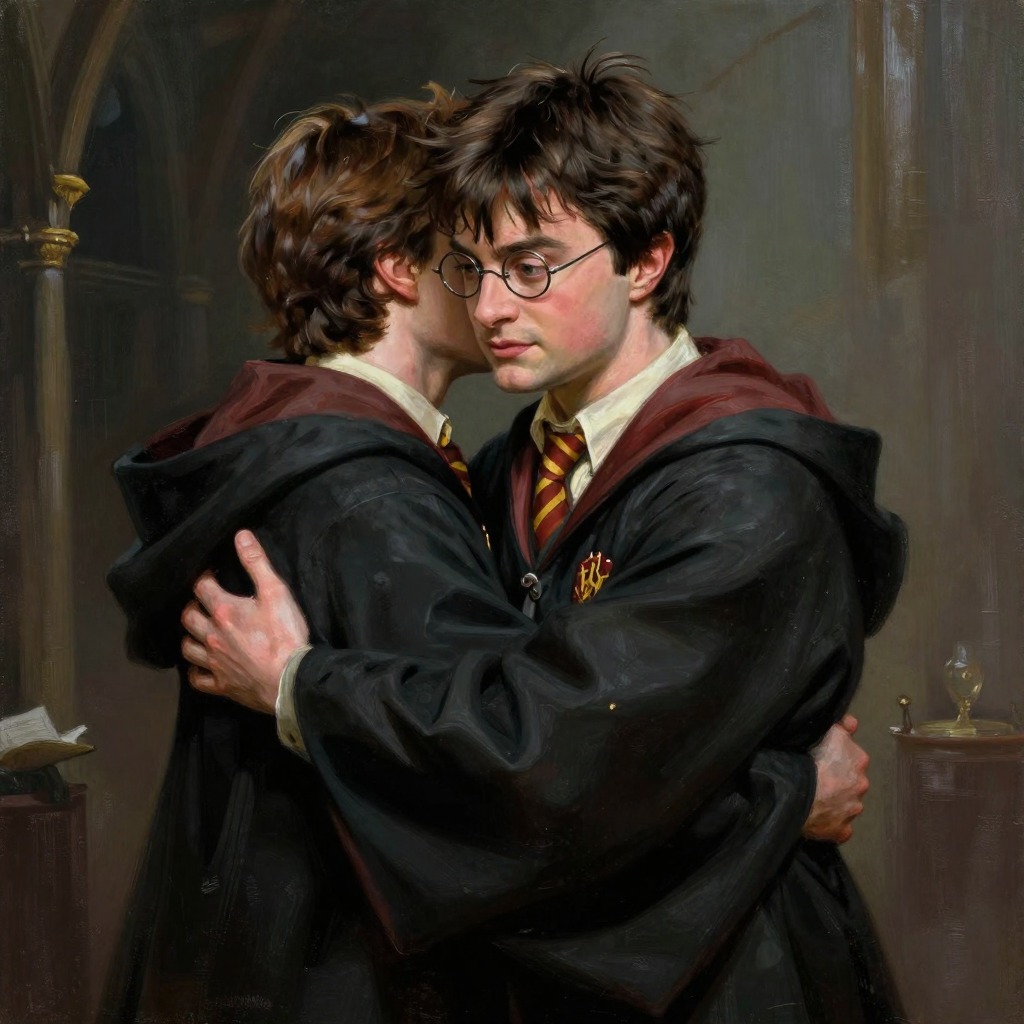
Neither can live while the other survives
The prophecy "Neither can live while the other survives" is the foundational truth of Harry Potter's existence, the inescapable sentence that defines his relationship with Lord Voldemort. It is not merely a prediction but a statement of a fundamental, antagonistic bond: the two are locked in a zero-sum struggle for survival, and the death of one is the necessary condition for the life of the other. This single phrase transforms Harry from a boy who survived an attack into a young man who must actively seek the destruction of his enemy, or be destroyed himself.
Revelation and Burden
Harry first hears the full prophecy in Dumbledore's office at the end of his fifth year, after the battle in the Ministry's Hall of Prophecy. The words, "Neither can live while the other survives," strike him with a chilling, personal force. He immediately understands that this is not a vague warning but a concrete, inescapable fate. The prophecy explains why Voldemort marked him as an infant and why he has been hunted ever since. It also places an immense burden on Harry: he is not just a victim or a symbol, but the one person who is destined to finish Voldemort. The knowledge is both clarifying and terrifying, as it strips away any illusion of a normal future and replaces it with a single, deadly objective.
Acceptance and Motivation
Over the course of his sixth year, Harry internalizes the prophecy's meaning. He confides in Ron and Hermione, telling them that the prophecy means he is "the one who's got to finish off Voldemort." This acceptance is not passive resignation but a source of grim determination. He tells Dumbledore that he would want Voldemort finished even if he had never heard the prophecy, driven by the desire for revenge for his parents and Sirius. The prophecy, therefore, does not create his motivation but crystallizes it, giving a cosmic, inescapable logic to his personal quest. It becomes the lens through which he views his future, pushing him to abandon thoughts of a normal life and to prepare for a final, lethal confrontation.
Dumbledore's Interpretation and the Power of Choice
Dumbledore, however, offers a crucial counterpoint to a purely fatalistic reading of the prophecy. He insists that the prophecy's power comes not from fate but from Voldemort's own actions. Voldemort, by believing the prophecy and acting on it, created his own worst enemy. Dumbledore argues that Harry is "free to choose your way, quite free to turn your back on the prophecy!" The prophecy, in this view, is a self-fulfilling trap that Voldemort walked into. Harry's power, Dumbledore explains, is not the prophecy itself but his capacity for love, a power Voldemort cannot understand. This reframes the struggle: it is not a preordained duel but a moral choice, where Harry's love and courage are his true weapons. The prophecy is the battlefield, but Harry's heart determines the outcome.
The Final Confrontation and the End of the Cycle
The prophecy's logic drives the entire narrative arc of the series. It is the reason Harry must hunt Horcruxes, the reason he must face Voldemort alone, and the reason he ultimately walks into the Forbidden Forest to die. The phrase "Neither can live while the other survives" is not just a prediction of a fight; it is a statement of a metaphysical connection. Harry's survival is a direct threat to Voldemort's existence, and vice versa. The final battle in the Great Hall is the inevitable climax of this equation. When Harry finally defeats Voldemort, the prophecy is fulfilled, and the cycle of mutual destruction is broken. The words that once defined a curse become the epitaph of a tyrant and the herald of a new peace.